It was on the day of my Ordination in 2012, that Rev. Joe Dipaolo presented me with a Book of Discipline from 1956. That deeply personal gift was significant because it was the first year that the Book of Discipline removed the ban on ordination for women. Joe presented it to me as a sign of his belief in the power of my calling and a reminder that things do change.
Even the Book of Discipline can change.
The church can admit it was wrong, even after hundreds of years of proclaiming otherwise. Church teachings, foundational beliefs and practices, can change. The church can open its doors wider when the call of God is undeniable and irresistible and — in the words of John Wesley — when the calling of God is extraordinary. John Wesley acknowledged the calling of women, like Mary Bosanquet. What may at first have seemed out of line, out of the ordinary, out of the norm, was so powerful that women’s leadership compelled him to acknowledge its veracity and allow them to teach and preach in the Methodist movement.
Women’s official ordination would have to wait for almost 200 years.
When Joe gave me that 1956 Book of Discipline, he was uniquely situated to be able to understand just how much that gift would mean to me, because he was close enough to my world of origin to understand what I had to overcome to arrive at that ordination moment. I was raised in a world where I had not even passed the first test of being a man. I had no emotional bandwidth to consider my Queerness in a church where my pastor and parents spoke with such derision about women who were called to preach. My pastor saw it as a point of pride that he had attempted to bring Bishop Susan Morrison up on charges — a fact that effectively terrified me as much as the Salem trials of old. There was no space for my wholeness, only for my survival.
Joe served as my candidacy mentor. He had joy, charisma, and a vision for the future. He helped me to take my first steps into ministry. He affirmed me in beginning the process of ordination — against all odds. He helped me go against the beliefs of the family that had raised me, and the local congregation that had taught me.
He taught me that rules could change, such as those held by the Methodist Church South regarding slavery, and those held by the United Methodist Church regarding the ordination of women. These beliefs could come to be seen as wrong and in need of correction. He believed in that so firmly that he helped me move out of my shame for being a woman with a calling, and step into the wholeness of who I am.
Eventually I would step past where he was willing to stand.
More than a decade ago, I felt a shift happen. There was a vote at an Annual Conference, where my mentor, Joe Dipaolo, wanted to be elected, and the solidarity expressed between different marginalized groups blocked his path. Joe had expected — to be blunt — to have the votes of African Americans in the Eastern Pennsylvania Annual Conference behind him. The congruence of progressive communities left him needing other alliances if he wanted to avoid getting shut out of power.
Joe and my parents turned to delegates from Africa connected through the Good News movement. They thought that I would join them since I was and am deeply invested in solidarity with the Black community in the United States. They did not see that my working to resist racism was not the same as them working in solidarity to restrain Queer people within our church. Their alliances were not about repenting and repairing the damage of colonialism in Africa. They were about gaining power and votes to control the denomination.
These alliances played out at General Conference 2019. I stood in the stands behind Joe as he sat in the delegates area, as he celebrated after the passage of the Traditional Plan that sought to expel me — as Queer clergy — from my vocation. He sat at a round table along with my mother, and the delegates from Africa that they were seated with. In an attempt to present an image of moderation, Joe went home and told his church that when the Traditional Plan passed, the first thing he did was put his head down and weep. I was there. That was not what I saw.
I was there to bear witness with my presence. I still had hope that my presence would make it a little harder for my mother and him to cast the first stone. I hoped mercy would take hold, that the Spirit would move. I was there with the hope that maybe he could rekindle his belief in my calling, the belief that he had conveyed to me when he handed me that Book of Discipline from 1956 — that the church can change. That he could change.
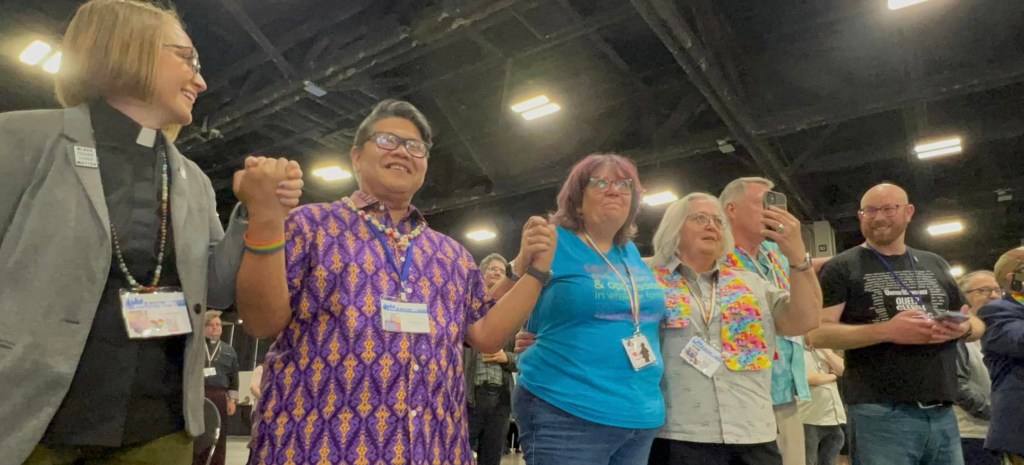
At General Conference 2020 – held by necessity in 2024 – it was Joe who stood behind me this time instead, looking at my back. He watched from the tables where groups reporting on the events sat with their computers out. By chance, I stood in a line in front of him, along with Queer friends. When the news came in that the ban on Queer clergy had been lifted — a change similar to the ban on women clergy being lifted decades before — it would have been a gift if Joe could have celebrated like he had once celebrated with me at my ordination when he handed me a Book of Discipline that represented change.
But Joe’s not coming with us. Once a student of history, Joe became known more as someone trying to keep the church in the past, as the church moves forward into the future.
In 2019, he had said he wept, but it was I that wept, standing behind him watching him hug others and celebrate the life they thought they had ended for me.
Now, in 2024, he was the one who sat behind me, watching me hug my friends. Joe went on to write a piece that misrepresented how General Conference works, omitting the whole first week of holy conferencing in committees that preceded the livestream of the second week – and mocking the relief we felt at our humanity being affirmed, calling it triumphalist. Not realizing the deep differences between our celebrations.
When I saw him celebrate, what I saw him celebrate was the denial of my calling. When he watched me celebrate, what I was celebrating was the affirmation of my humanity. It is very different things, and perhaps something that can only really be understood by someone who has ever had their humanity constrained. Which is why solidarity builds among people who have been oppressed in a great variety of ways.
I have no hope really that Joe will understand, the man I see now is not one I recognize. But maybe you will understand.
It’s a little hard for people to understand sometimes that their desire to restrict and contain and control other people is not the same, does not carry the same weight, as those same people’s desire to simply live, to simply serve, to simply be loved.
One is the desire to control another person, the other is a desire to not be controlled. One is a desire directed towards another person’s oppression, the other is a desire directed towards one’s own freedom. To make the two seem like they hold the same weight, is a false equivalency.
When I watched Joe celebrate in 2019, what he was celebrating was a door slamming in my face, a no to my calling, a no to my humanity, a restraining of my gifts.
When Joe watched my celebration in 2024, it had nothing to do with him. It wasn’t triumph – it was relief. It was the feeling of a boot being lifted off our necks, bonds being removed, walls coming down. It was freedom. It was relief. It was oxygen. It was love. It was community.
While both felt deeply personal, one was external about another person’s life being limited — the other was internal about my own personhood being affirmed. I did not win a victory over Joe, and I was not crowing. My joy was less like the celebrations of 2019, and more like the simple joy my dog feels when I arrive home and open the gate for her to be welcomed into my arms. Not about winning anything, simply about being set free, reunited to community, seen when you felt unseen, heard when you felt unheard, whole and restored again.
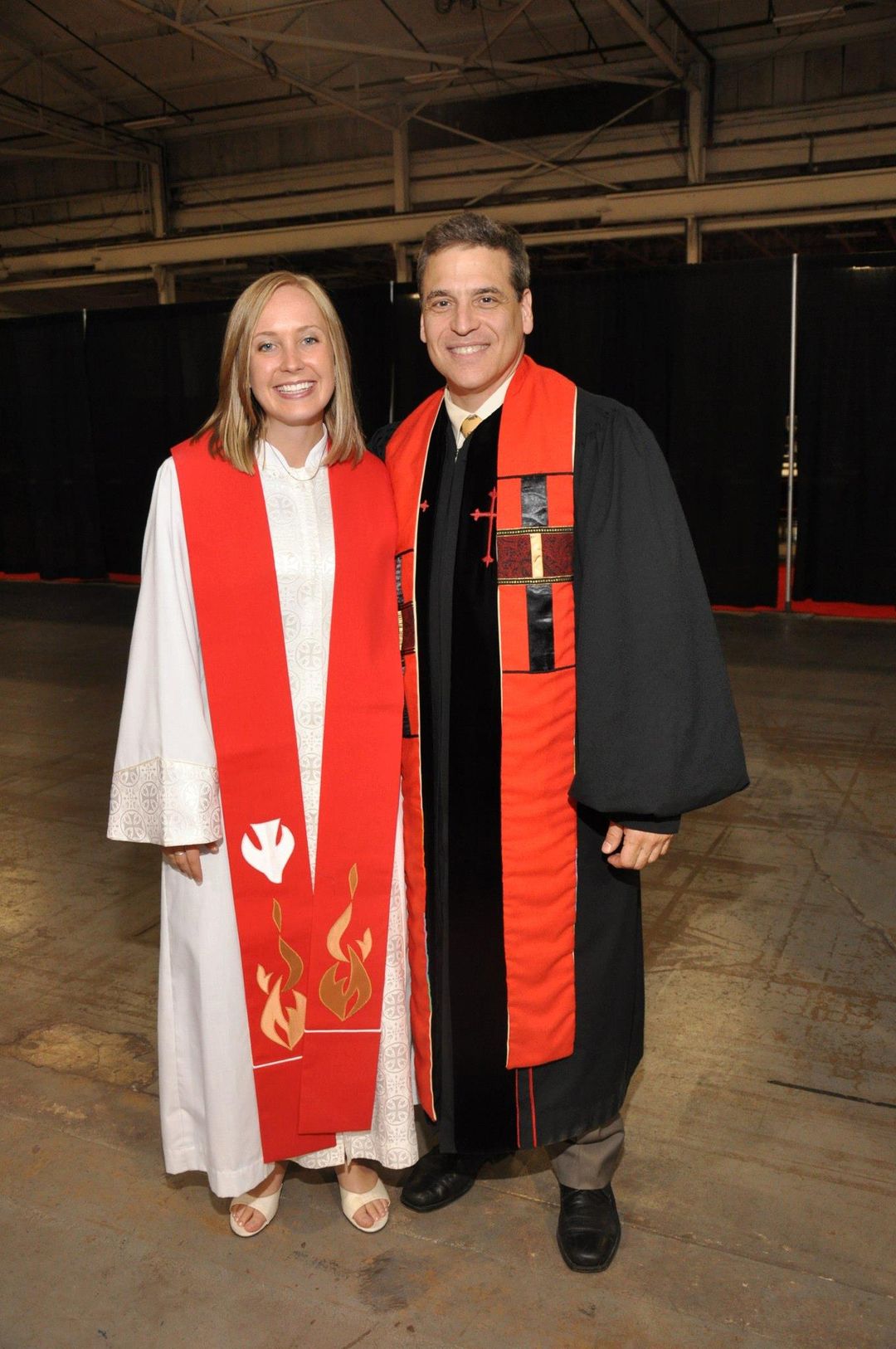
Despite it all, I’d still like to ask today: where do you stand Joe? You’re not next to me anymore. Once you stood by my side, now you stand behind me, getting left behind. It’s the place you’ve chosen to be.
When I was locked out with other Queer people — both metaphorically and literally — at General Conference 2019, it wasn’t my choice. When you sat behind me in that press area in 2024, watching my back – not to protect it, but to mock it — you chose. You chose not to get up and stand by my side. You chose to use your words, power, platform to mock those you watched, to harm those you watched. And who you watched was me.
The student of history, watching from outside, while history was being made.
For those of you in Eastern Pennsylvania still invested in making history rather than watching it, you have another chance this Tuesday. The extraordinary call – once acknowledged by John Wesley – still burns bright amongst us in the person of Beth Stroud. Despite all she has endured, she still answers yes. She still chooses us.
There’s a saying that history is written by the victors, but there’s no victors needed here, not in a community that is truly trying to love one another. There are no victors necessary amongst people who are trying to live the Story and be people of the Book. There are no victors necessary when it is Jesus name we seek to lift, and not our own.
In this case, Joe may try to convince you of his version of history, but I’m so deeply grateful that while he watches the story, I get to live the story that is unfolding. It is a beautiful, authentic, joyful, and sincere story filled with earnest integrity and compassionate forgiveness. Nothing anyone can ever say or write can take that away from us.
I feel confident in where I have chosen to stand.
I hope you’ll also choose to stand here, with people like Beth and me, as the Spirit of God does something new among us.
“I am about to do a new thing; now it springs forth; do you not perceive it? I will make a way in the wilderness and rivers in the desert.” (Isaiah 43:19)


 Hannah Adair Bonner
Leave a comment